From the Practice Files, episode 1
July 10, 2025
From the Practice Files, episode 1
- by Jacqueline Whittemore
When Marguerite first started cello, my ‘homework’ was to read three texts on the Suzuki method:
- To Learn with Love, William and Constance Starr
- Teaching from the Balance Point, Edward Kreitman
- Ability Development from Age Zero, Shinichi Suzuki
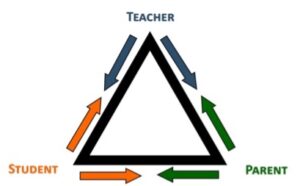
Though this assignment might have been aspirational, I am a rule follower. So I read the books – getting a lot from them even as I groused the whole time. Two things stood out to me, as they contrasted with my personal experience of skill development:
- As shown by the Suzuki triangle, the Suzuki method is collaborative – not authoritative.
- Suzuki is about a way of life, not a task to be accomplished or goal to exceed.
Put simply, these tenets meant that to be successful:
- Marguerite’s journey with cello was going to take a lot of my energy and focus!
- Practice needed to be daily and, more importantly, it needed to be FUN!!!
As a serious, busy grown-up with a strong-willed young child, I had my doubts. And, to be real, there have been stretches where I was too tapped out to bring the fun. Stretches where getting through practice was like engaging an enemy combatant. BUT. It has also been one of the best things I have ever done as a parent. The time we have spent together has brought us incredible joy, closeness, and insane amounts of laughter. (Not to mention chocolate, but I’ll get to that later.) I want every Suzuki family to have what we have!
So, here is your first practice tenet: Practice makes permanent.
Although most of us have probably heard that practice makes perfect, the reality is that this is only true when it is high quality practice. Whether good or bad, whatever is done repeatedly will become ingrained. Children can struggle with equating ‘done’ with ‘done well’. As a result, the parent’s role in practice is to make sure to overwhelm errors with an abundance of success.
Pick ONE thing that your child could improve. Then make doing so consistently a game. Many teachers start with the Five Penny Game. For this, the child earns a penny every time they do the task correctly. If they goof, they lose a penny. The goal is to win 5 pennies – which the child can keep. There are LOTS of ways to mix this up. Variations we have used include:
- Increase the stakes: Use 2 pennies, 2 nickels, and 1 quarter. Even if the child doesn’t really grasp the value of money, things getting bigger and shinier is always a win!
- Trade-up: Let them trade in the pennies for something they want – a reasonable treat, 5 minutes with a game, an episode of Bluey. (NOTE: This is NOT the same as paying them to practice! They are cashing in winnings from a game that you only play now and then. Time playing with you should be the reward.)
- Change the prize: Use chocolate-covered raisins (or another high value but small tasty treat) instead of pennies. This is great for kids that are not into money. (It also can help keep blood sugar steady so they have the focus and drive to practice longer!)
- Feed the pig. For this, we would get out Marguerite’s piggy bank. He was so sad… Poor piggy is starving! Once Marguerite successfully completed a task, we would hoot and holler and then she would feed the pig. He would squeal with gratitude, making her eager to try again! (This is great because you can reuse the same coins over and over.)
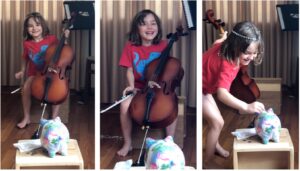
When doing the game, your focus is ONLY on the stated goal. No nagging about the bowhold if you are working on elbow position, bee-sting if you are working on tunnels, etc. If the target task is accomplished, CELEBRATE that and save the rest for another piece, session, or game.
Pro tip: Whatever you try, remember to start your session by setting your intention! Practice is about togetherness. Practice should be joyful. Practice should be FUN!