From the Practice Files, episode 11
August 20, 2026
From the Practice Files, episode 11
- Jacqueline Whittemore
As feared in my last column, summer did indeed hurtle past at high speeds. However, as with most things, that brings a gift – the start of another year of Suzuki! Because we have been away for a time, let us recall:
1. Practice is a dynamic, focused collaboration between the parent and child!
2. Suzuki is a way of life, so it should occur daily and be FUN!!!
With the arrival of the fall term comes audition season with all its attendant worries, woes, and highs. Auditions generally consistent of several parts, including:
– Scales
– A prepared piece of the artist’s choosing ± assigned excerpts
– Sightreading
Each of these has a unique role in the audition and, as such, warrants a different focus during the preparation process.
However, before we dive into the components of the audition, it is worth taking a moment to remember that the point of an audition is not to judge the artist. Instead, auditions should be viewed as matchmaking sessions. As Hugh Jackman noted, “It’s an opportunity to get to know a stranger and to learn from each other.” And what, after all, is better than getting to know someone new – whether that someone is a member of the audition committee or by discovering a new facet of oneself?! If approached with this mindset, auditions can be incredibly connecting and empowering.
Okay, that said, let’s break down the audition components.
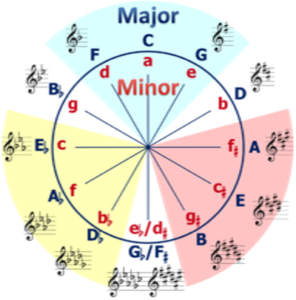 Scales: These provide a wonderful opportunity to assess the artist’s ability to create a resonant and full-bodied sound. Nerves are normal. Nerves during an audition means you care. However, they also can create some glitches in sound that are particularly notable in intricate pieces. For a scale, the player does not run a gauntlet of rapid string crossings or fingering changes, crescendoes or ritards, or modulates. Instead, the ‘job’ is simply to go up the scale and come back down. This provides a great opportunity for the committee to learn what type of sound the artist can evoke from her/his instrument, whilst assessing basic fundamentals such as posture, bowhold, fingering pattern, and general aplomb.
Less experience auditionees may choose the scale played to best highlight their skills and training, whereas more advanced musicians will be asked to play specific scales in the moment in order to assess their overall command of the sound wheel (see figure). For best success, the student should be encouraged to practice a variety of scales leading up to the audition, with careful attention devoted to intonation and sound quality. Being literally on top of the instrument can obscure intonation challenges. As a result, playing very slowly, particularly whilst using a tuner app, can yield great dividends in this arena. After all, “Music sounds different to the one who plays it. It is the musician’s curse.” (Patrick Rothfuss)
 Prepared pieces: This is the artist’s opportunity to showcase their talents but also is their greatest chance to highlight their work ethic and personality. The attention to detail devoted to a prepared piece can augur future performance as part of the ensemble. Does the artist have a nuanced touch, a mischievous bent, or a tendency toward flamboyance? Is the piece played a tempo – or raced through at the expense of intonation and sound clarity? How smoothly executed are shifts and string crossings? Has the artist chosen rational fingerings? Do they know the piece at a deeper level? How do they start and finish? Do they make eye contact – or are their eyes glued to their fingers? The latter might pose a crucial stumbling block when playing in a chamber group or in a leadership role within a larger group.
Sightreading: Effective sightreading can make or break an artist’s season. Many people have taught themselves to play a single favored piece well on a instrument, yet it is the extent of their repertoire. Practicing musicians, however, have to learn several pieces simultaneously, several times throughout the year, as concerts come and go. Sightreading is an important skill for faster mastery of new pieces, allowing the group to focus more on quality of playing than notes themselves.
“Our great mistake is that we tie hope to outcome.” (Cynthia Bourgeault)
Many misperceive sightreading as a talent, but it is actually a skill which means it can be intentionally cultivated. The temptation when faced with a sightreading piece is to jump right into singing or playing. However, this is a recipe for disaster. For success, the artist must employ a standardized approach, applying an internal checklist to the piece prior to touching one’s instrument. Items to be reviewed in sequence include musical key, time signature, rhythm (doot doot it out in your head, if necessary), and finally melody with attention on hidden sharps and flats. If routinely practice, this process can be executed quite quickly, allowing the piece to be run through 1-2 times in one’s head before diving in before the committee.
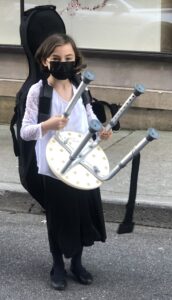 Finally, a key component of any audition is having humor and humility when things go sideways. When I applied to vet school, I had to go for an in-person interview (e.g., audition). It was an epic comedy of errors which culminated with my chair pitching forward AT the interviewer when I stood to leave because my hose had gotten snagged on a bolt sticking out from the chair leg. To this day, I partially credit my calm and humor over my unintentional chair attack with my being granted admission. For musicians, this often means choosing to display a positive non-reaction after making an error and trundling on with the show. After all, we all know “why the goldfish is the happiest animal on earth…” Be a goldfish!
Oh yeah – and when it is over, Dr. Baldwin says you have to go for ice cream!