From the Practice Files, episode 6
January 5, 2026
From the Practice Files, episode 6
- by Jacqueline Whittemore
Welcome to a new year of practice tips! In my last column, we explored the importance of performance for the Suzuki student’s growth. Research has compellingly shown that using calendar milestones, such as the start of a new year, can dramatically improve adoption of new habits. That makes it a perfect time to explore the myriad benefits of using a practice log to develop skills.
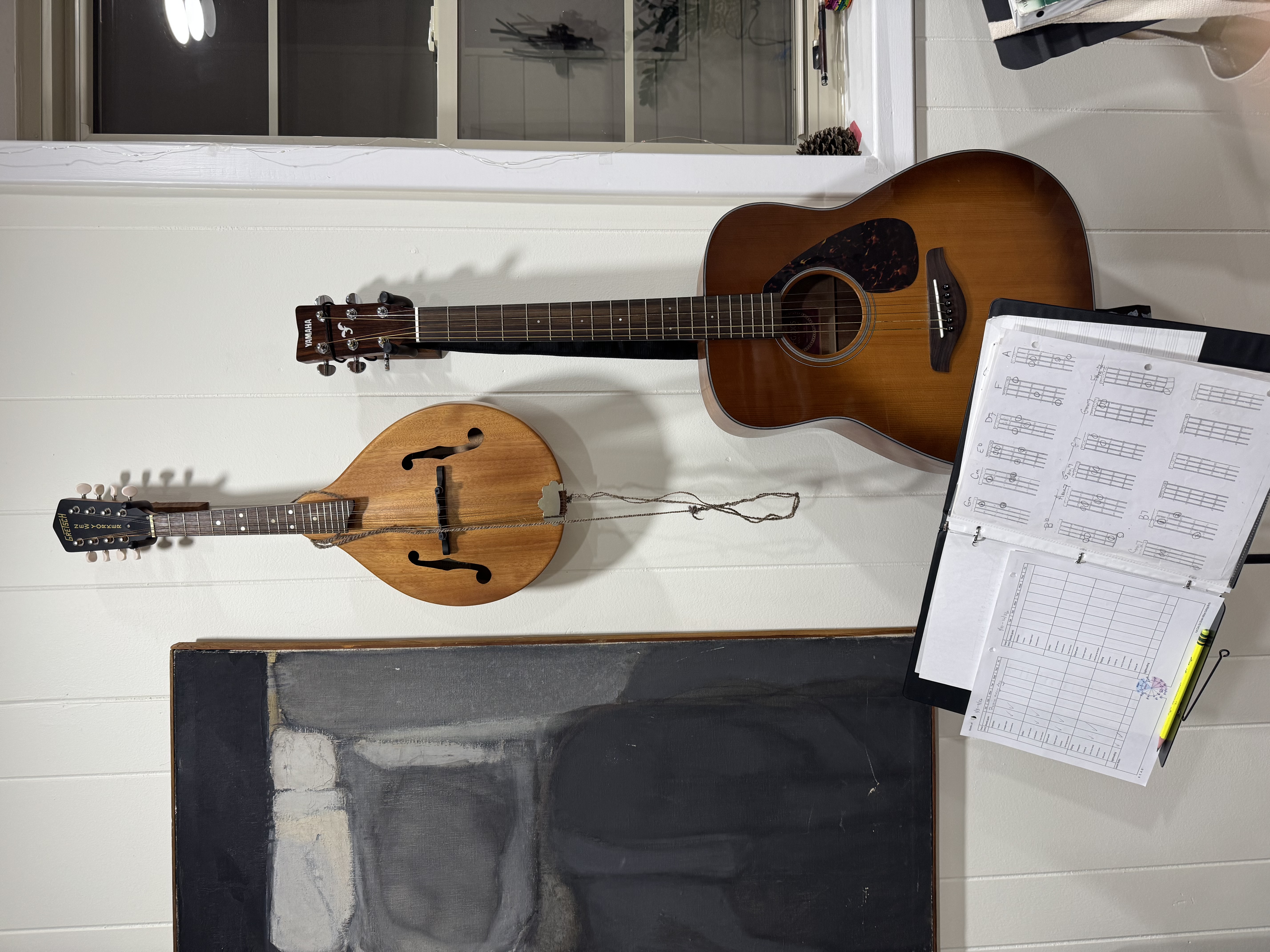
The function and value of practice logs will vary based on student age and stage of development as a musician. Some benefits are self-evident, but many I only recognized after years using the logs with Marguerite. As a result, I missed many opportunities to leverage benefits in the early years– and it did not occur to me to employ them in my own lackluster attempt to learn mandolin until this week. (Thus prompting a reboot on this month’s column!)
So far, I have identified seven main benefits of using a practice log or journal. (Most of the benefits interrelate, but I found each has a unique aspect so I elected to split instead of lump.) These apply regardless of student age or stage as a musician. Logs can be used to:
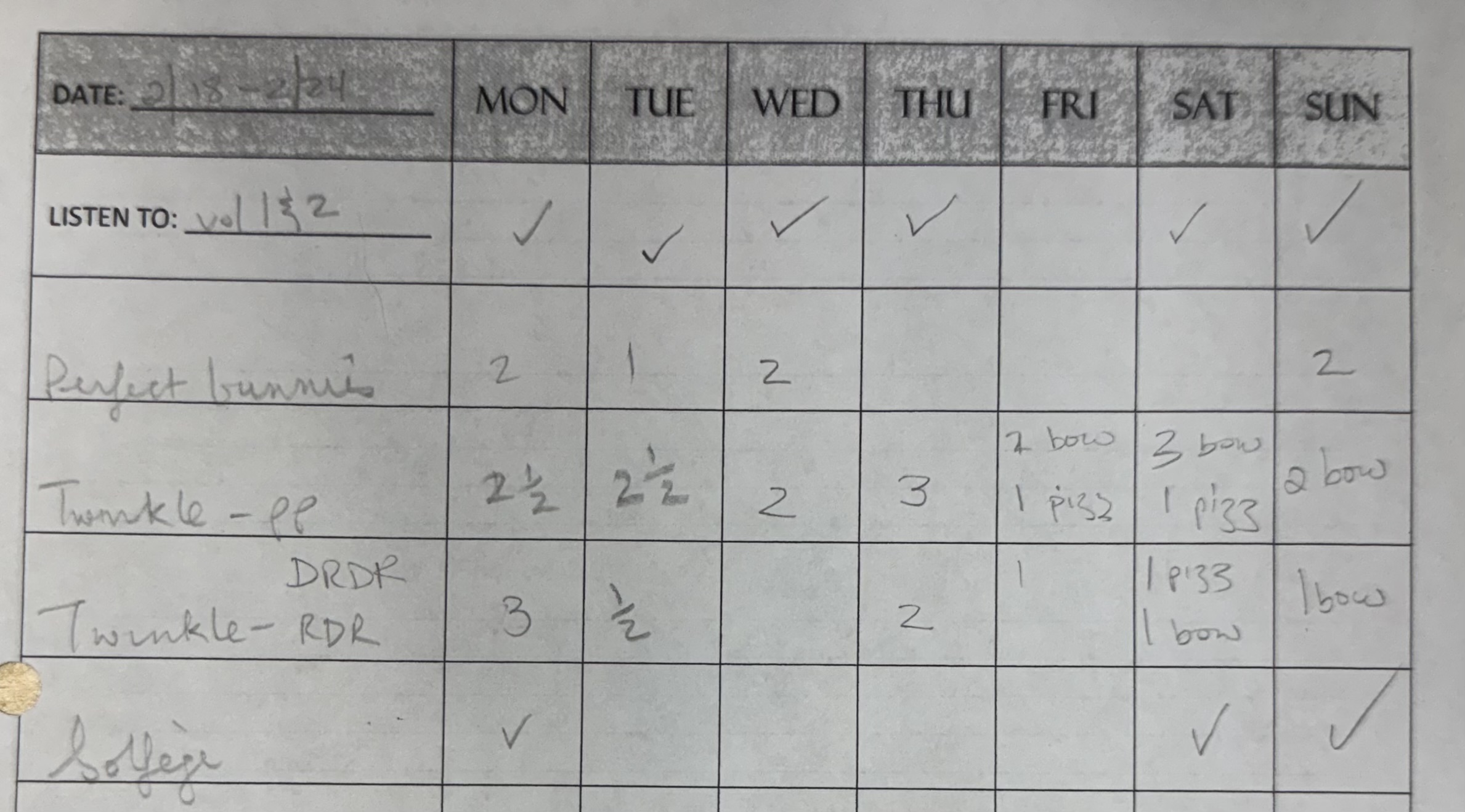 Create Accountability
- Decrease Downtime
- Optimize Practice Flow
- Achieve Goals Faster
- Maximize Lesson Retention
- Track Development
- Increase Motivation
Let’s break them down so you can see how the benefits differ and can be employed to hasten musical growth!
 Accountability: Dwight Eisenhower once observed, “I have two kinds of problems: the urgent and the important. The urgent are not important, and the important are never urgent.” Amid the hustle and bustle of daily life, it is easy for practice to fall through the cracks. While an instrument waits patiently – often in a low traffic part of the house – for its beloved musician to visit, the phone alerts or the dog begs to play. Suddenly, it is bedtime and the poor instrument has spent another day wasting away alone. (Sob!) With a practice log, particularly if using a grid structure, it is very clear when you risk breaking a streak. For some, this will be enough impetus to pick up the instrument – if only for a few minutes. Having a structured practice log also ensures you do not ‘forget’ items the student dreads (or you dread enforcing!) – like working with a metronome, calling note names as you play, or doing 5 penny on a tricky section.
- Maximize Lesson Retention: “The very act of writing it down made her realize how easy it would be to forget, how important it would be from now on to put everything, everything, down on paper.” (Donna Tartt) Lessons are insightful. Lessons are dynamic. Lessons are engaging… And, let’s face it, lessons are overwhelming! So many nuances. So many games. So many bars and slurs and bowings.
Is it bumpy right thumb with tapping left thumb, or bumpy left thumb with tapping right pinkie? Martelé or martinet? Is the pizz the fingering or is it a ‘bonus’ pizz to loosen the fingering? And that is just my experience – the person with no responsibility for executing the requested task. Oy!! I cannot enumerate the times we have argued about what transpired (‘What zombie game? There was no zombie game.’) before resolving the manner with comparison of lesson notes on the log with lesson videos. By employing a structured log (versus freestyle notes), I can record things in best order for efficient and empowering practice, which helps avoid repeating the same lesson over and again. 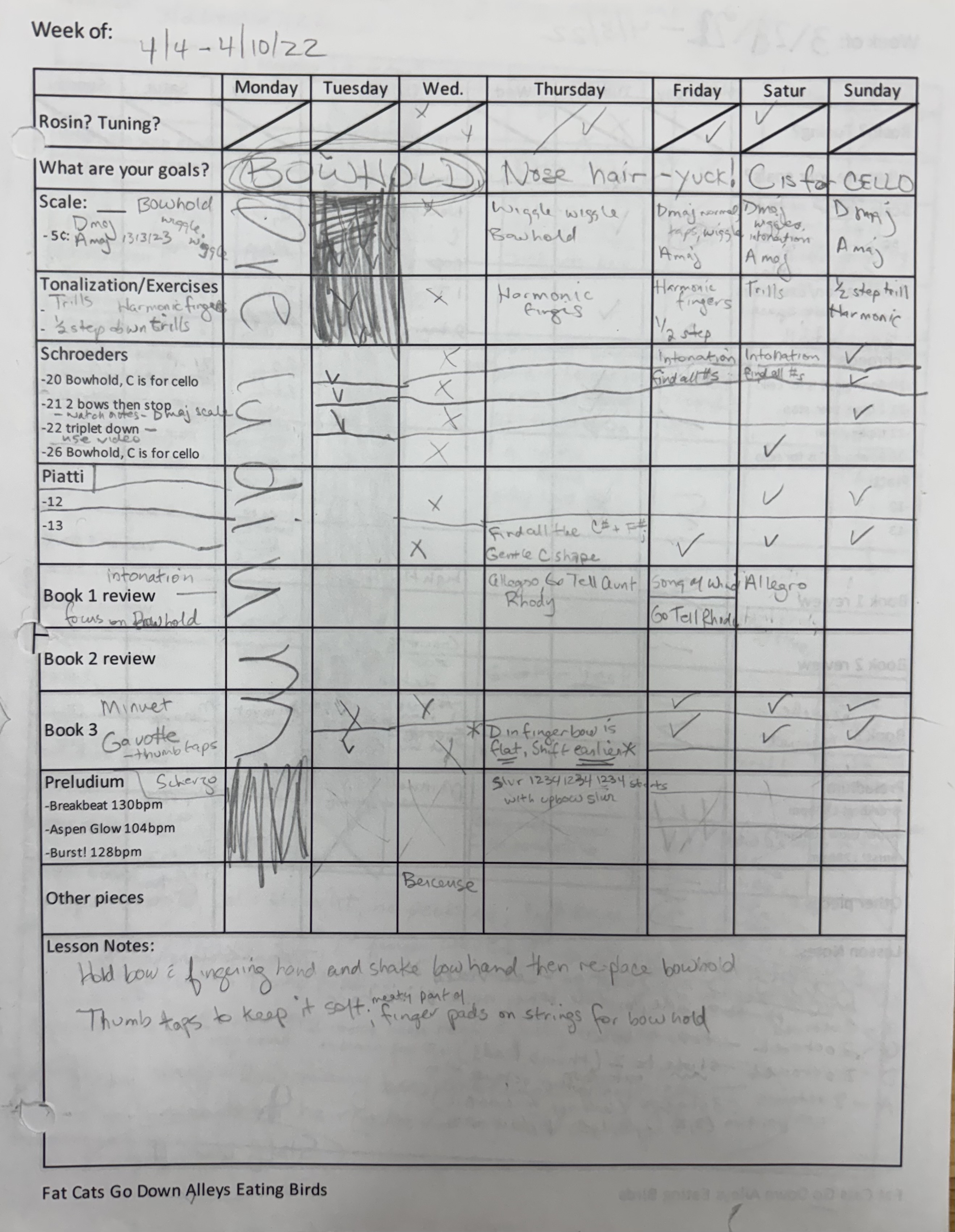 Decrease Downtime: Numerous studies have shown that we are at our best, cognitively, early in the day. Yet rare is the student able to devote their best, sharpest hour of the day to practice! Instead, most of us are scrambling to make it to school and work. This means practice is often done during the waning hours of attention and concentration. As a result, it is easy to sit down and drift aimlessly. This was driven home when we went through a phase using a kitchen timer for individual tasks and realized at least half of practice time was spent in transition! Without a log to guide us, completing the week’s learning points could easily take longer than Moses’ sojourn in the wilderness! The log reduces cognitive load, providing a musical roadmap for the session. As a result, it is easy to flow from task to task. This also means more brain power is available for actual practice – improving integration of skills! “All the noise in my brain. I clamp it to the page so it will be still.” (Barbara Kingsolver)
- Optimize Practice Flow: Those paying attention will assume this is redundant to #2. Au contraire! To limit repeated work, I use an Excel file for Marguerite’s log and adjust the rows as her practice evolves. The initial structure stemmed from lesson flow. However, based on ongoing use, I discovered that our order of practice (Scales, Exercises, Current Focus, Review Pieces, etc.) was not, in fact, yielding the most affirming experience. Scales are fundamental, but beautiful scales are not best accomplished cold. Similarly, new pieces often are easier to negotiate after affirming confidence with review pieces. Working with the logs day after day (week after week, month after month, year after year) helped me recognize the flow that would best leverage her attention span and providing the most emotional reinforcement for her journey. This is, of course, a continuously evolving process. As Mary Oliver noted, “To pay attention, this is our endless and proper work.”
- Achieve Goals Faster: This is a tricky one. It clearly is redundant to all of the above, as consistent focused practice with tangible benchmarks allows for optimal growth. However, I feel it deserves its own category for a couple reasons. First off, identifying weekly goals cultivates self-reflection over time, which builds momentum. It also allows the student to adjust allocation of limited time among myriad potential tasks/opportunities as their circumstances change. With orchestra auditions looming, time spent on sightreading and sonorous tone in scales might be more important than review. When summer camp approaches, curling back up with delicious old favorites from the Suzuki repertoire might be key for the most fun during play-ins. The log can be used to make these decisions a priori so practice time is not misallocated.
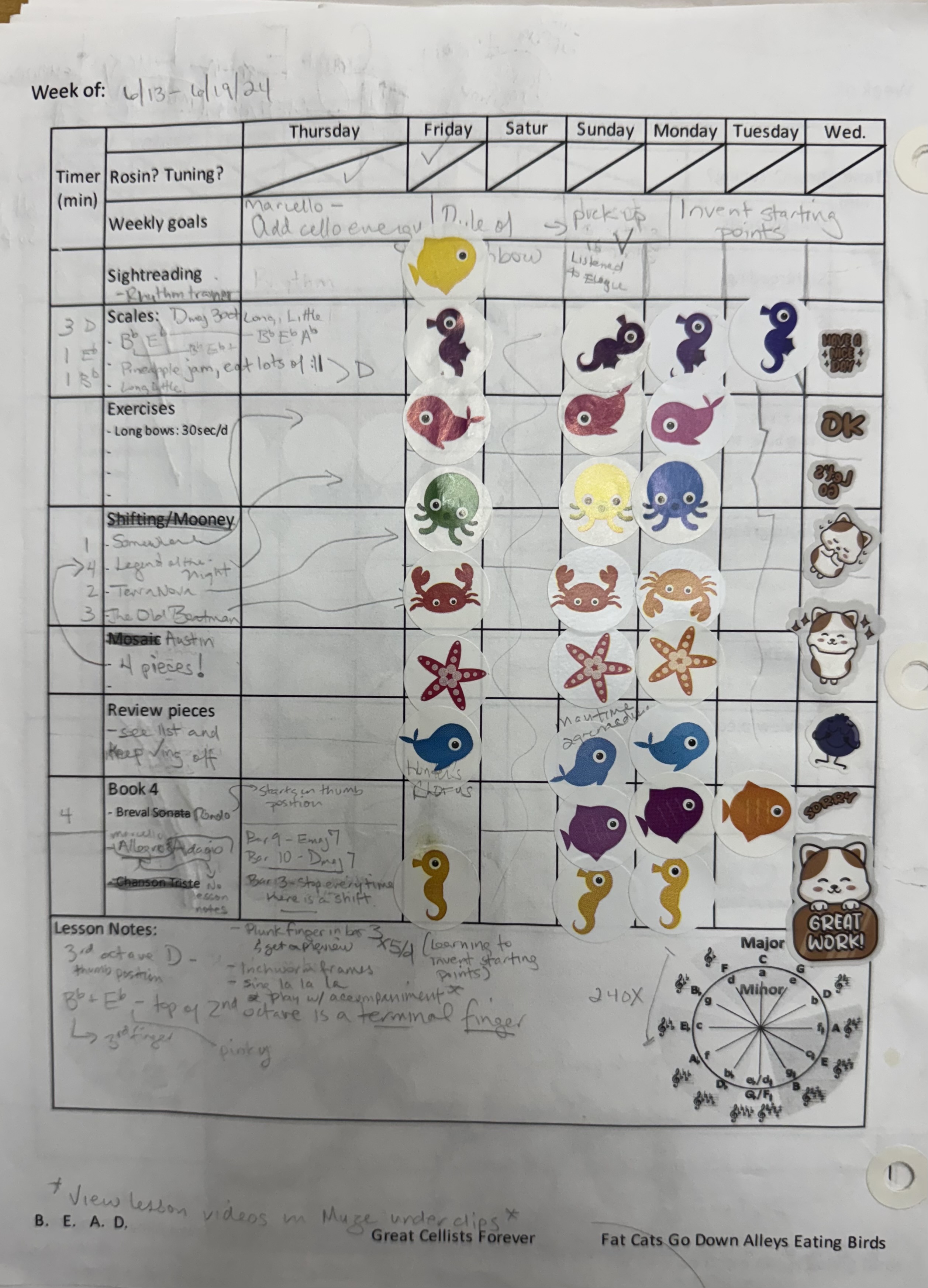 Track Development: We did not learn about practice logs until six months into Marguerite’s journey. However, we have kept them religiously since – and I have kept them all. This, along with recital programs and videos, allows Marguerite to realize how far she has come. This can be invaluable after a performance catastrophe, disheartening audition result, or simply during a ‘doldrums’ phase of practice. As Patrick Nathan deliciously describes, “The form of the journal is ideal for capturing life’s tenuous relationship with time; it makes a fugue of one’s completed life.”
- Increase Motivation: This follows from numbers 1, 5, and 6, but I feel it warrants separately noting because it is easy to equate the others with work if we let our inner Alex Keatons out. The reality is that the log provides so many opportunities for celebration – whether recording positive feedback from lessons, remembering particularly fun games, strategizing stickers to match with differing skills or tasks, or personally seeing our growth. At the end of the day, musical development is – and should always remain – affirming and joyous! A well-crafted and tended log helps cultivate pride and happiness, as well as deepening the bond between parent and child (or learner and instrument, for adult learners).
Remember our tenets!
- Practice is a dynamic, focused collaboration between the parent and child!
- Suzuki is a way of life, so it should occur daily and be FUN!!!