From the Practice Files, episode 2
August 15, 2025
From the Practice Files, episode 2
- by Jacqueline Whittemore

In my first column on the parent’s role in the Suzuki triangle (you can find it here if you missed it), I laid out two core tenets for a successful Suzuki journey:
- Practice is a dynamic, focused collaboration between the parent and child!
- Suzuki is a way of life, so it should occur daily and be FUN!!!
In future columns, I look forward to exploring different aspects of these tenets. For now, however, I wanted to continue our discussion on the truth that ‘Practice makes permanent.’
At the end of the day, month, year, or even our lives, the reality we will all eventually face is that, as commonly has been misattributed to Aristotle, “We are what we repeatedly do. Excellence is not an act, but a habit.” (Will Durant)
How, then, do we make the musical journey one of excellence? Previously, we discussed using the 5 Penny Game to transform focused repetition of small sections of fingering, phrasing or bowings into play. Simply completing an exercise or playing a piece again and again over a long period of time has its own benefits.
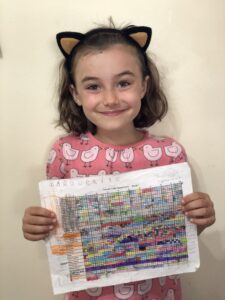
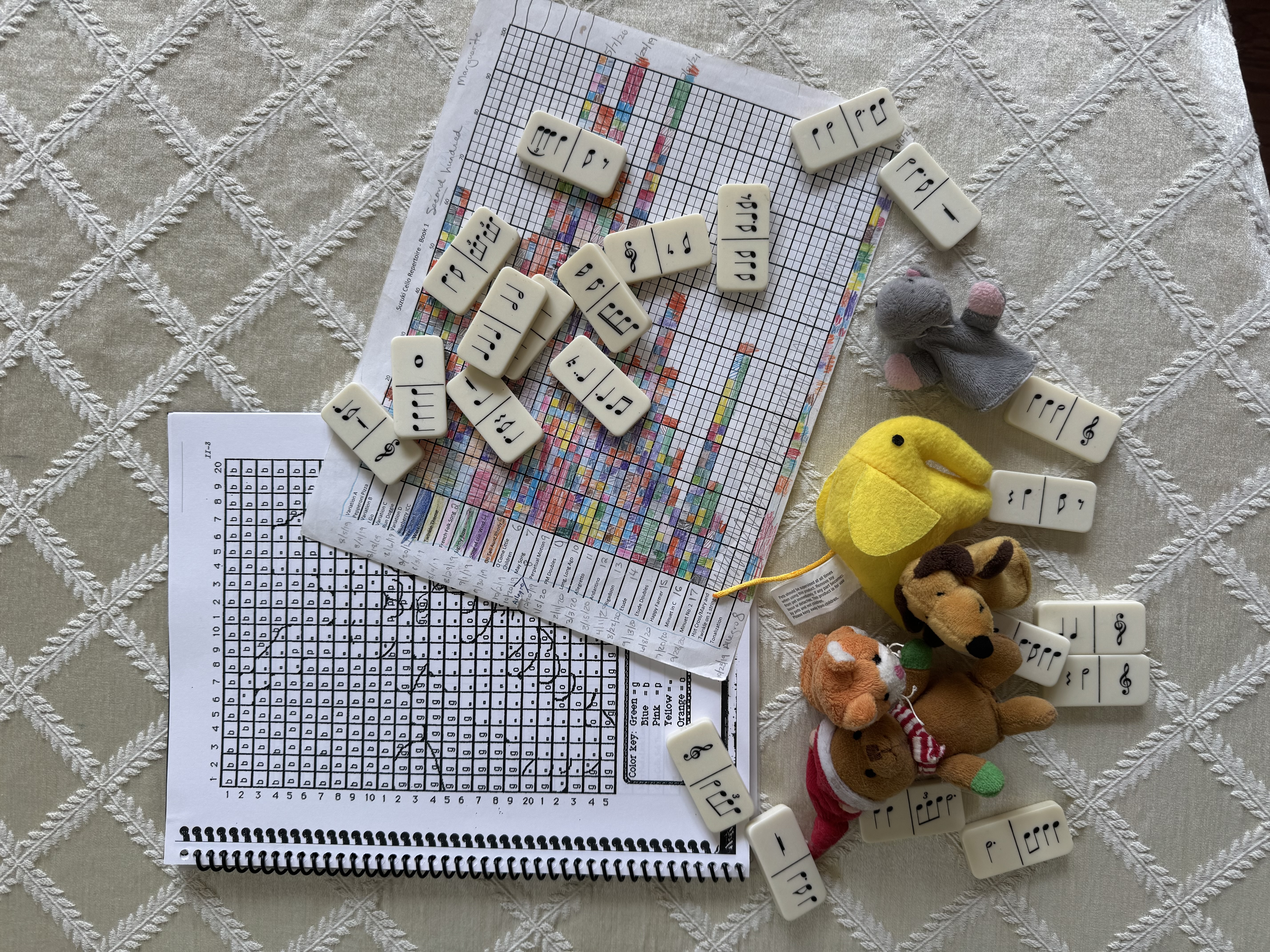
Parents of children learning string instruments will be intimately familiar with the Bunny Bowhold Chart by B. W. Wilczek – wherein the child colors in a box for each bowhold, with the 500th repetition completing the picture to reveal a bunny. Building on this, 100s charts can be used for the early repertoire – wherein each piece is practiced 100 times. See how proud Marguerite is after completing her first 100 for Book 1! Adding start and completion dates by piece can help children see jumps in their progress. However, it is a LONG process without a ton of instant gratification, even if you take breaks during practice to color squares between pieces.
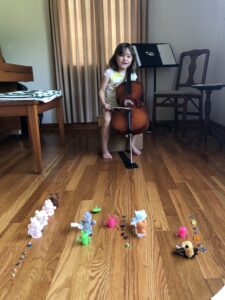
To help highlight progress within practice sessions, I started keeping a basket of friends for practice. They slept in their basket next to my chair, then would creep out one by one to join the party. They would cheer her on – encouraging her to play gently if they were frightened, marching when she employed martelé bowing – and also hold her to task – hiding behind one another if her intonation was off, jumping back in the basket if her lullaby was too loud, and so on. What a celebration we had with her friends when practice ended!
On days when her ‘friends’ were too tired to play, I would use dominoes to create crazy patterns on the floor. At the end of practice, Marguerite would celebrate by triggering the cascade. Laying out tracks for a train to run or cars to race also is a great fit for piece repetition.
As Marguerite got older, I worried that puppets and dominoes might come off as baby-ish and let them fall-away. However, during a particularly desperate afternoon session, I retrieved them from the crypts. What a fabulous time we had! Even though Marguerite is now eleven, the puppets retain an uncanny ability to pull her from the doldrums and motivate ongoing practice even when I am persona non grata. Once again, Suzuki allowed me to rediscover a core life truth – one that enlivens my world as much as hers: Fantasy is a necessary ingredient in living; it’s a way of looking at life through the wrong end of a telescope. (Dr. Suess).
Finally, Marguerite asked me to share that, “It always helps to have a little special treat after a practice series.” As you can see, there is no end to the ways you can bring wonder to the party!
 Brave parents, as you embark, never forget:
- Start by setting your intention!
- Practice is about togetherness.
- Practice should be joyful.
- Practice should be FUN!