From the Practice Files, episode 3
September 15, 2025
From the Practice Files, episode 3
- by Jacqueline Whittemore
 Welcome to the third column on optimizing the parent’s role in the Suzuki triangle. So far, we have been exploring ways to avoid degradation of practice quality during repetitive work. We discussed using variations on the 5 penny game for correction small bowing or fingering issues, hidden picture coloring charts for long projects such as perfecting the bunny bow hold, and leveraging toys to maintain momentum during repetitive tasks (or series of tasks) within a practice session.
Some of you are likely waiting with bated breath for me to stop clowning around and dig into ‘serious’ strategies for learning and technique. If that is you, take a breath. The problem, as Peter Drucker once stated, is that “The race for quality has no finish line – so technically, it’s more like a death march.”
If we wish for the child to have a lifelong love of music, to seek excellence in it (or any other aspect of life), it is essential keep the joy! The joy quotient required to continue showing up day after day may change as we age, but it remains. (How many of you keep doing something day after day only to keep a streak alive?) This is why George Burns once observed, “I’d rather be a failure at something I enjoy than be a success at something I hate.” So our top priority as parents and mentors is to STOP equating serious with good!
If I fuss when Marguerite’s intonation is awry, she will shy away from listening to herself. Snapping at her to sit up straight will make her feel tired and slump more. Telling her to stop looking at her finger works about as well as telling someone not to think about elephants. Our job is to find the game in the task. It can be almost anything. Any game. This means rooting deep to tap your inner ogden (nash), who observed “you are only young once, but you can stay immature indefinitely.”
So, let’s start with a common problem – sloppy intonation. (Pianists – if you are struggling here, call Volunteer Piano. They do great work!)
When starting out, you can use painter’s tape (or a commercial fingerboard sticker) to help your kiddo find the locations of different notes on the fingerboard. This is particularly helpful when young students move up in instrument size. However, we need to gradually nudge the student away from such cheats for (at least) three reasons:
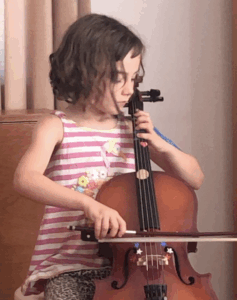
A child twisting to stare at her fingers to find the notes. Note how this causes the left elbow to drop and the spine to twist.
- If tapes are left on, the student will inevitably twist to stare at her/his fingers, skewing elbow height and spine alignment (see left). It cannot be scolded out, any more than someone can avoid reading subtitles on a movie screen.
- Using tapes only gets us in the general neighborhood of ideal intonation. Slight differences in angle of the wrist without moving the finger can greatly change the pitch, which is easily proven by having the child pull a long bow whilst using a tuning app. (I like TE Tuner.)
- If the student is focusing on the tapes, they are not developing their innate ear. How, then, will they adjust when adding in shifts between positions, employing vibrato, or playing trills?
How to help? The easiest way to start is to play the CD recordings of the pieces that come with the book! The CD should be played often enough that the child might sing along spontaneously – or even when the music isn’t playing. We have a playlist that extends at least 2 books beyond Marguerite’s current piece, which we let run over and over. By including more advanced pieces, the music stays fresh and also can provide excitement over what is coming next. Did you buy the book used or get one without the CD? Numerous videos and recordings can be found free online!
There also are endless ways to nurture pitch during practice, most of which are also hilarious: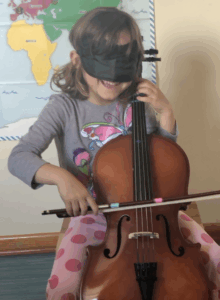
- Play a scale at very low speed whilst watching a tuner app that changes appearance with perfect intonation. (TE Tuner sends out floating faces if the note is held in pitch long enough.)
- Slow the recording so the student can play along as they are learning. (I like the AudioStretch app for adjusting playback speed without distorting pitch. It is free to use for pieces less than ~3 minutes.)
- Use a blind fold, extra-large hat, or plastic bucket (my favorite) to cover the child’s eyes during playing. Have them provide feedback on what percentage of notes were in tune.
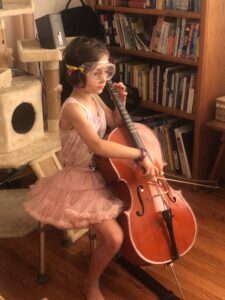 Add a prop that interferes with peeking without preventing the child from seeing you or the music. For example, a small stuffed animal between the chin and scroll or a scuba mask ± swimsuit for underwater practice. (Note the use of a commercial fingerboard sticker on the ‘underwater’ cello to mark higher pitches.)
- Do a timed challenge: How long can you go without peeking?
- Practice after dark! (click to view video) Secure a glow-stick on the bow or use flashing Christmas lights to up the cachet. Added bonus – this keeps YOU from getting distracted and critiquing a different technical factor, such as bowhold.
- Snap back challenge: Let the hand float away to the side the, at a command, it snaps to position and the student plays the note. The challenge is to land it in tune several times in a row, quickly.
And, as eve, never forget our core tenets for a successful Suzuki journey: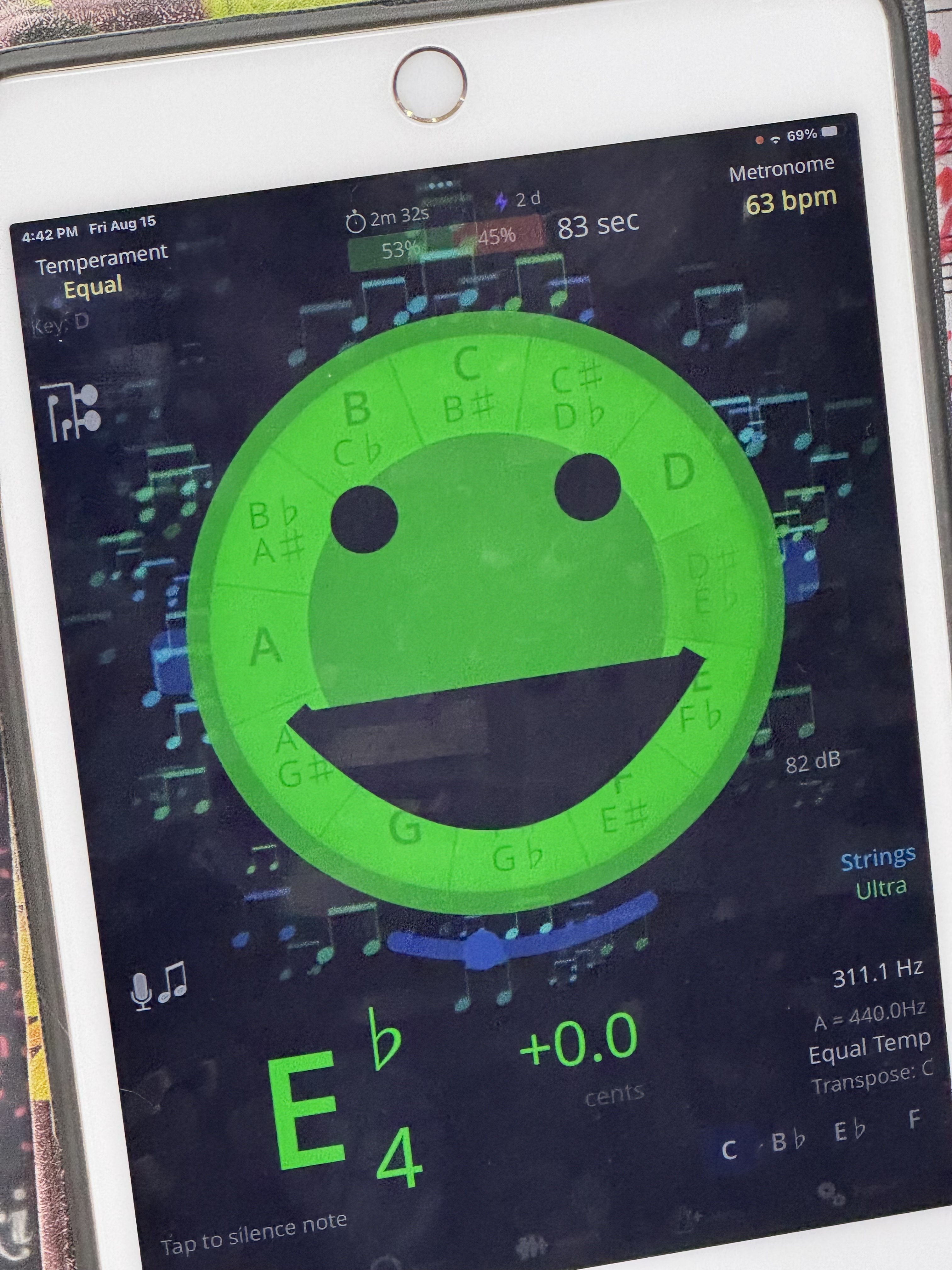
- Practice is a dynamic, focused collaboration between the parent and child!
- Suzuki is a way of life, so it should occur daily and be FUN!!!